
CASE STUDIES
Explore a selection of MLR Project Management & Consultancy’s work across infrastructure, construction, and building projects, showcasing our capability in Primavera P6 scheduling, forensic schedule analysis, EOT assessment, Window Analysis, project controls, and reporting automation.
Forensic Schedule Analysis/Delay Claims: Window Analysis Under a GC21 Contract
MLR Project Management & Consultancy prepared a stakeholder presentation explaining forensic schedule analysis and the application of Window Analysis under a GC21 contract.
The presentation helped stakeholders understand how project delays are assessed using Primavera P6 schedule updates, critical path movement, milestone variance, concurrency review, and delay classification.
It also presented the actual project analysis, showing how delay events were reviewed and classified as excusable-compensable, non-excusable, or excusable-non-compensable.
This case study demonstrates MLR’s capability in Window Analysis, forensic schedule analysis, GC21 delay assessment, Primavera P6 schedule review, EOT claims, concurrency analysis, and stakeholder engagement.
➤ Location: Australia
➤ Sector: Roads and Infrastructure
➤ Client Type: Government / Client-side
Forensic Schedule Analysis/Delay Claims: Client-Side EOT Assessment for Wet Weather Delay Claims Under a GC21 Contract
MLR Project Management & Consultancy prepared a client-side Extension of Time assessment for wet weather delay claims on a major road infrastructure project under a GC21 contract.
The assessment reviewed the contractor’s Notices of Delay and EOT submissions, then tested the claimed delay impacts against the relevant Primavera P6 schedule updates using a schedule-based Window Analysis approach. The analysis compared month-to-month programme movements, reviewed the activities claimed to be affected by wet weather, and assessed whether those activities drove the project completion date.
The review provided the Principal with a clear and structured basis for assessing the contractor’s EOT entitlement under the GC21 contract framework, documenting the delay analysis methodology, results, and adjusted contract completion position.
This case study demonstrates MLR’s capability in GC21 EOT assessment, client-side delay claim review, wet weather delay claims, Window Analysis, Primavera P6 schedule review, forensic schedule analysis, road infrastructure project controls, and construction delay claims assessment.
➤ Location: Australia
➤ Sector: Roads and Infrastructure
➤ Client Type: Government / Client-side
Forensic Schedule Analysis/Delay Claims: Contractor-Side Time Impact Analysis for Construction Delay Claim
MLR Project Management & Consultancy prepared a contractor-side Time Impact Analysis to assess the schedule impact of telecommunications design changes on a building renovation project.
The analysis was developed using a Primavera P6 schedule update, logically linked delay fragnets, and a before-and-after comparison of the forecast completion position. The methodology was aligned with recognised Time Impact Analysis principles under AACE International Recommended Practice No. 52R-06 and relevant NAVFAC schedule specification requirements.
This allowed the contractor to demonstrate the time effect of the change event in a structured, transparent, and contract-compliant manner. The assessment provided a clear basis for substantiating an extension of time position and supporting the formal construction delay claim process.
This case study demonstrates MLR’s capability in Time Impact Analysis, NAVFAC schedule compliance, AACE-based delay analysis, Primavera P6 delay modelling, contractor-side EOT support, forensic schedule analysis, construction delay claims, and schedule impact assessment.
➤ Location: USA
➤ Sector: Buildings
➤ Client Type: Private / Contractor-side
Project Controls & Report Automation (Project Specific): Power BI and Primavera P6 Dashboard for Project Controls Reporting
MLR Project Management & Consultancy reviewed a contractor-submitted Time Impact Analysis to assess whether the claimed delay was properly substantiated under NAVFAC schedule and delay claim requirements (LEARN MORE).
The review identified several issues, including the use of an incorrect unimpacted schedule, unexplained logic changes, insufficient mitigation evidence, and a lack of validation against actual project progress. MLR assessed the submitted TIA by reviewing the schedule basis, testing the fragnet impact, checking Primavera P6 logic changes, and validating the claimed delay against the latest available schedule update.
The assessment showed that the claimed delay was not supported once the correct schedule update, available float, contract completion requirement, and actual project progress were considered. This provided a clearer and more defensible basis for assessing the contractor’s extension of time request.
This case study demonstrates MLR’s capability in NAVFAC delay claim review, Time Impact Analysis assessment, Primavera P6 forensic schedule analysis, AACE 52R-06 methodology, EOT review, fragnet validation, schedule logic review, and construction claims support.
➤ Location: USA
➤ Sector: Buildings
➤ Client Type: Government / Client-side
Forensic Schedule Analysis/Delay Claims: USACE Request for Equitable Adjustment and Forensic Schedule Analysis Review
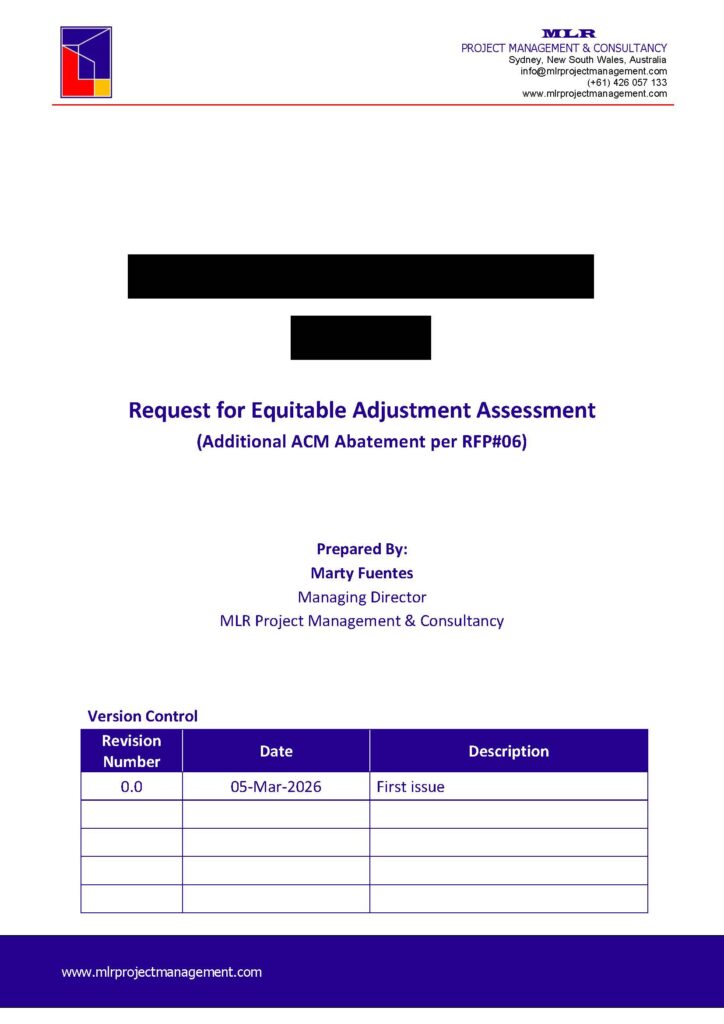
MLR Project Management & Consultancy prepared a USACE forensic schedule analysis review for a contractor-submitted Request for Equitable Adjustment on a major building project.
The contractor claimed that design-related changes caused significant project delay and attributed the full impact to the Government. MLR reviewed the submitted Primavera P6 schedules, assessed the contractor’s stated delay analysis methodology, and identified gaps in the application of AACE 29R-03 Contemporaneous Period Analysis, commonly known as Window Analysis.
MLR then performed an independent schedule-based delay assessment using Window Analysis to identify schedule changes that affected project completion, assess critical path movement, and classify delay responsibility as excusable-compensable, non-excusable, or excusable-non-compensable.
The review provided a clearer and more defensible basis for evaluating the contractor’s time extension entitlement, separating government-caused delay, contractor-caused delay, and concurrent delay. This case study demonstrates MLR’s capability in USACE schedule analysis, Request for Equitable Adjustment assessment, AACE 29R-03 delay analysis, Window Analysis, Primavera P6 forensic schedule review, EOT assessment, delay responsibility allocation, concurrency analysis, and construction claims support.
➤ Location: USA
➤ Sector: Buildings
➤ Client Type: Government / Client-side
Project Controls & Report Automation (Project Specific): Power BI and Primavera P6 Dashboard for Project Controls Reporting
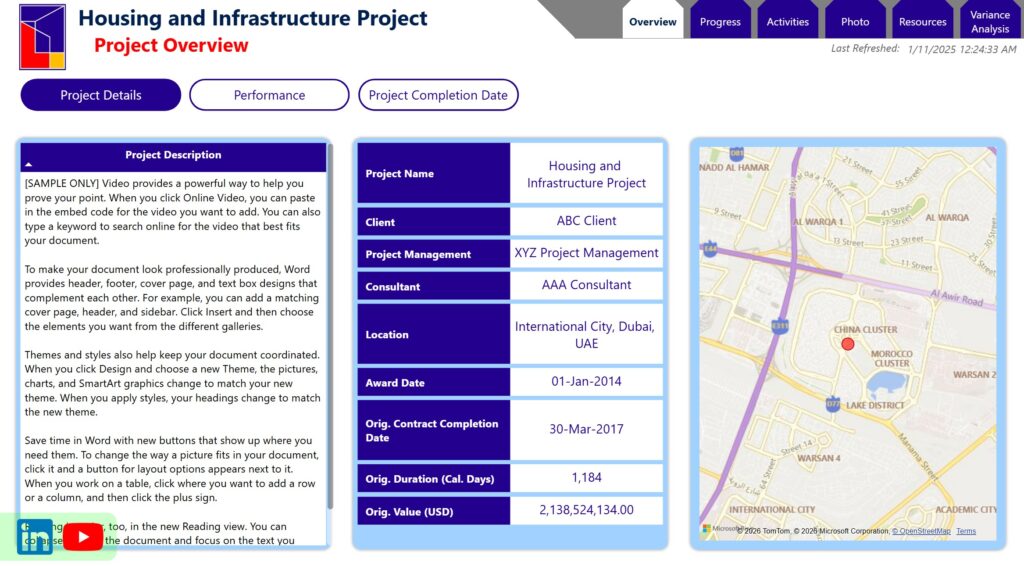
MLR Project Management & Consultancy developed an interactive project controls dashboard using Power BI and Primavera P6 to improve project visibility, reporting efficiency, and decision-making (LEARN MORE).
The dashboard integrated schedule data, progress tracking, earned value metrics, resource monitoring, Gantt chart views, progress photos, and Window Analysis-based schedule variance assessment into a single reporting environment.
By preserving historical schedule updates and enabling users to filter by reporting period, scope, milestone, and performance indicators, the dashboard allowed project teams to investigate delays, monitor progress trends, identify activities driving schedule slippage, and support more informed project controls decisions.
This case study demonstrates MLR’s capability in Power BI dashboard development, Primavera P6 data integration, project controls reporting, earned value analysis, schedule performance monitoring, Window Analysis, and construction project reporting automation.
➤ Location: United Arab Emirates
➤ Sector: Buildings, Roads, and Infrastructure
➤ Client Type: Private / Contractor-side
Project Controls: Quantity-Based Project Progress Tracking Linked with Primavera P6
The contractor required a reliable project progress tracking solution to monitor construction progress by quantity and align site progress with Primavera P6 schedule updates.
MLR Project Management & Consultancy developed a customised Excel progress tracker linked with Primavera P6 data, enabling quantity-based progress measurement, planned versus actual comparison, payment claim substantiation, productivity tracking, and schedule performance monitoring.
The solution helped the project team track remaining quantities, identify delayed activities, calculate required productivity rates, and improve visibility for project controls reporting, recovery planning, and construction management decision-making.
➤ Location: United Arab Emirates
➤ Sector: Roads and Infrastructure
➤ Client Type: Private / Contractor-side